Four Libraries, One Service: ILL at University of Dundee
By Finlay Beatson, Library Support Advisor, University of Dundee
When Kip suggested this little morsel to me, I hadn’t quite realised what a unique situation it was. For the vast majority of our interlending colleagues, we have one or perhaps two libraries to keep track of, each of them likely in close proximity to each other for ease of access. The University of Dundee has four libraries; two on Main Campus (our Main Library and Duncan of Jordanstone Library), one in Ninewells Hospital, and another across the river in the heart of Fife – our Kirkcaldy Campus library! The Robertson Trust Medical Library in Ninewells is approximately a 10 minute drive from our Main Library, while Kirkcaldy is a whopping 50 minutes away. We also have three remote store ‘rooms’ we pick from, which brings the grand total of locations to seven – quite the number for a tight-knit institution! And, believe it or not, there used to be more!
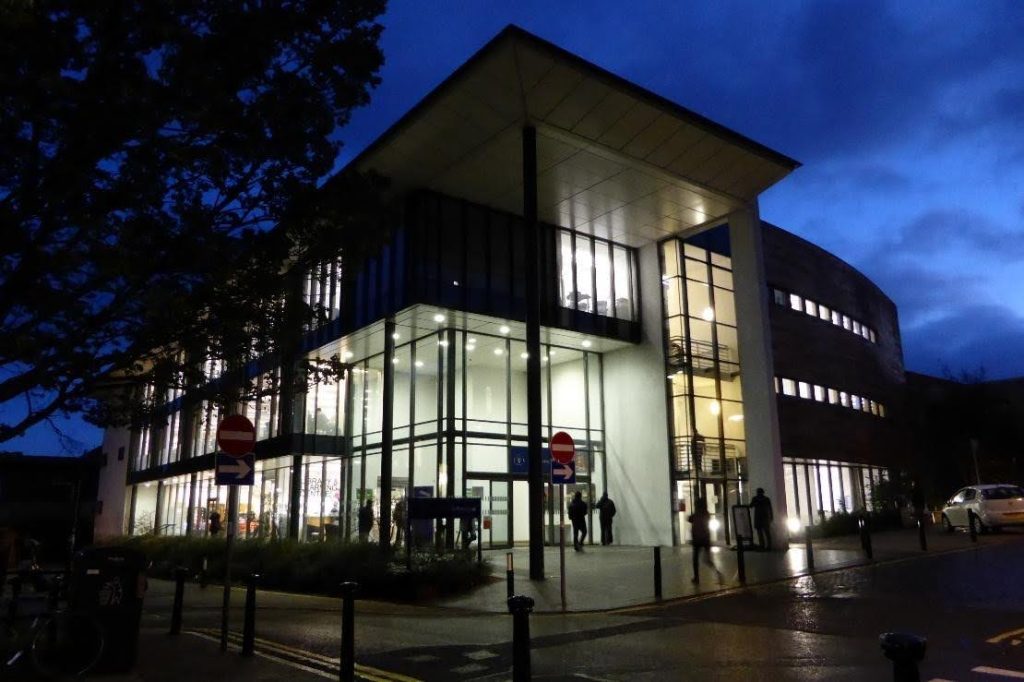
University of Dundee Library at night, John Lord, CC BY 2.0, via Wikimedia Commons.
So how does having seven locations influence our Resource Sharing service, especially considering our ILL department is based at Ninewells? Organisation is a huge factor in this, as well as communication. As of now we are quite the well-oiled machine; ILLs have always been based at Ninewells and we have always had our seven locations, so the dynamics within our locations are iron-clad. Books are transferred between the three Dundee-based libraries and Kirkcaldy campus every week, each with separate boxes that line the wall of the Main Library, slips are colour-coded based on library (Ninewells is bright blue, if you must know!) and whether they are internal or external titles, just as a few examples! Requests are placed as early as possible so they can be picked and transported to our ILL department that day, minimising wait time between processing and posting. On the other end, we add an extra week to our due dates, just in case there is an unexpected delay on the way to our mailroom.
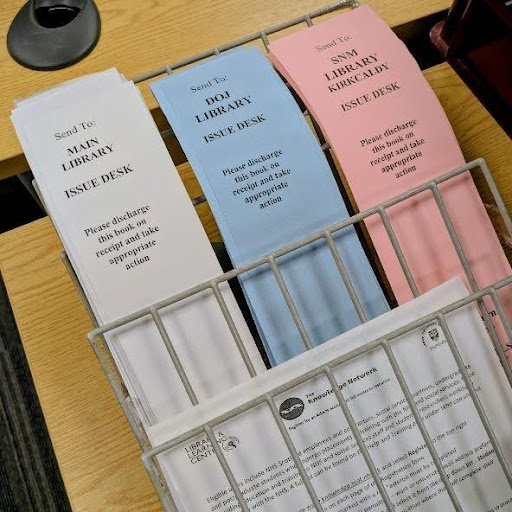
Photograph © Finlay Beatson. Reproduced with permission.
Speaking of wait time, deciding the most optimal routes between sites considers multiple factors. Firstly, there’s demand. Which sites are most popular with our ILL patrons, what titles see the most footfall, and where are we going to need to spend the longest? Secondly, location; how many locations can we reach in the shortest time? Luckily for us, two of our stores are located almost underneath two libraries, so hitting two birds with one stone has never been easier. And thirdly… The gas tank. Books need to traverse about in one piece! Our devoted logistics attendant keeps a careful eye on the mileage – we certainly couldn’t be providing the service we do without them! Ninewells is always last on the stop, Main Library always the first.
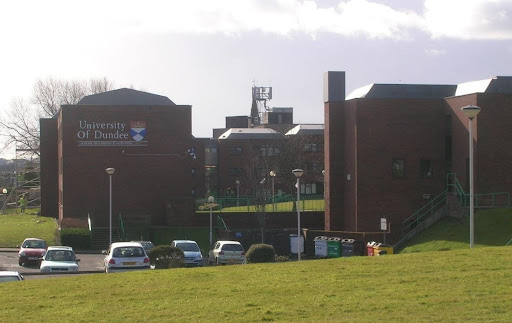
University of Dundee Kirkcaldy: Kilnburn, Wikimedia Commons. Used under an attribution-only licence.
Handling numerous libraries is one of a few great hurdles in Resource Lending; not only is there different stock and requirements, but oftentimes colleagues are neither trained in Interlending nor have the capacity to. We’re all aware of how busy HE libraries can be – and how bitty Interlending can really be. Inter Library departments can contain only one or two people, sometimes across different sites, meaning forwarding emails and discussing requests over Teams is more commonplace. We risk accepting requests without physically seeing the book until it arrives at our doorstep, trusting our colleagues to make the judgement on whether it is truly suitable for lending or not and to notify us. This can lead to a few mishaps, I know I’ve spent way too long rubbing pencil marks out of books only to receive word I’ve missed some, or we’ve had to reject requests based on quality and rarity in other sites. Though whether we have one, seven, or even twenty-three sites (looking at you, Bodleian, with love), providing the best service is always top priority, and I’m sure all of us will remain as passionate as ever about this small yet mighty facet of Library Services.