May 12, 2026 | Articles
Editor’s note
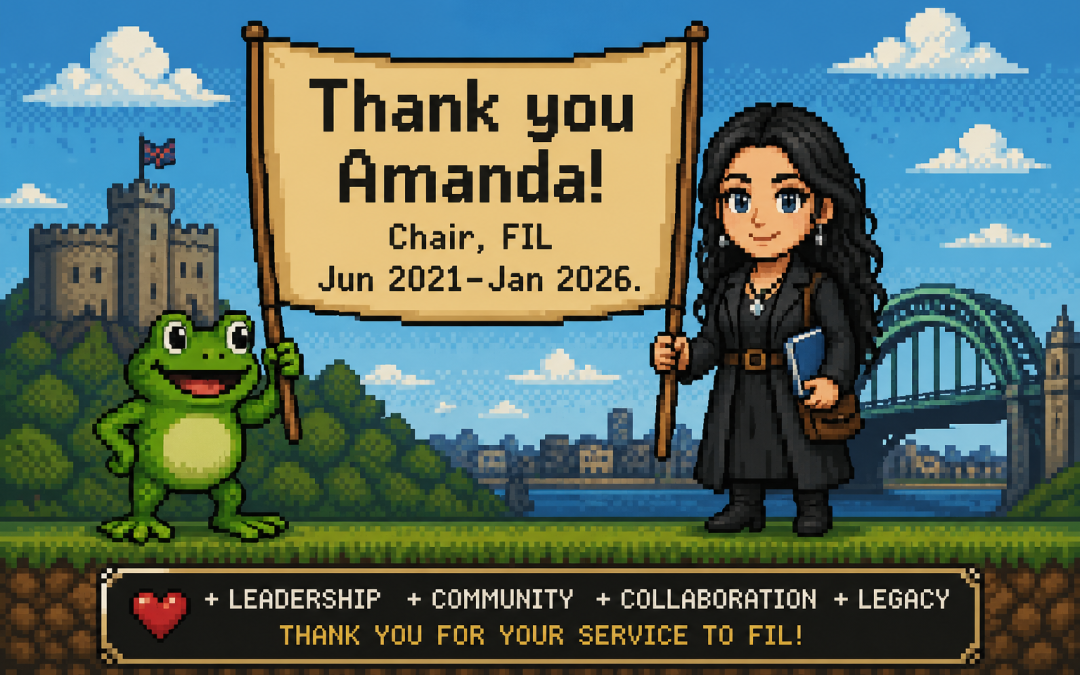
We’re really pleased to share this reflection from Amanda Foster, looking back on her time as Chair of the FIL Committee.
Amanda led FIL through a particularly challenging and transitional period for the interlending community, and her piece captures both the realities of that time and the strength of the community that carried it forward.
We’re very grateful to Amanda for sharing her experiences, and for her continued contribution to FIL.

Thank you Amanda!
Reflecting on my time as Chair of the FIL Committee
By Amanda Foster, Content Delivery and Copyright Librarian, Northumbria University Library
From the issue desk to interlending: my career journey
I began my career at Northumbria University Library in September 2001, having just completed a BA (Hons) in History at Northumbria. My first role was in the Customer Support team — working on the issue desk, stamping books. It was, without question, the best job. I stayed in customer service roles for a decade, becoming a Senior Library Assistant in 2005, and during that time I completed my Masters in Librarianship at Northumbria in 2010.
The move into interlending came about through a restructure in 2012, when I took on the Inter-Library Loans Coordinator role. It was a new direction, but one I quickly came to enjoy. In 2015, my role evolved further into the position I hold today: Content Delivery and Copyright Librarian. This brought together the ILL work with copyright and reading list responsibilities — a broad and varied remit that has kept me engaged and challenged ever since.
Discovering FIL
FIL came into my professional life through the interlending role, and it quickly became an important part of my practice. The community it offered — the knowledge sharing, the networking, the sense that others were grappling with the same challenges — was genuinely valuable, and the conferences were always a highlight of the professional calendar.
Stepping into the Chair role
I had only been on the FIL Committee for a short time when, in 2021, Chris Beevers asked me to take on the Chair role following the sad departure of Claire Hordern from Manchester. It was not the circumstances any of us would have chosen, and I was conscious of the weight of stepping into a role left vacant so suddenly. I was, however, genuinely honoured to be asked.
Chairing during and after COVID: a strange and challenging time
Taking on the Chair role in 2021 meant stepping into one of the most turbulent periods in living memory for the library sector. The 2020 FIL conference had been cancelled — understandably, given the circumstances — but it was a real blow, not least because it had been due to be held in Newcastle. To have that taken away, on home turf, was particularly disappointing.
To compensate, we put together a one-day interlending event in November 2020, and that spirit of finding creative solutions in difficult circumstances was something I saw right across the community during that period. People pulled together in ways that were genuinely impressive. The online events were challenging for all of us — we all had to get used to a very different way of working — and we certainly missed the networking that had always been such a vital part of the in-person conferences. The pre-COVID two-day events, held in lovely venues and hotels, with the conference dinner as a perennial highlight, felt very far away.
That said, I believe the shift to virtual working has changed us permanently and in some important ways for the better. The way we work daily, and the way we interact as a community, has changed immeasurably. I think the virtual dimension will, in the main, continue — and that is not entirely a bad thing.
Pivotal moments: decisions that mattered
One of the standout moments of my time as Chair was the decision to drop the FIL membership fee. It sounds like a simple administrative change, but it was anything but — we spent a long time debating it and consulting with members before reaching a decision. The impact has been significant: it has genuinely reduced the administrative burden on the committee and removed a barrier to engagement. I am proud that we saw it through.
Another memorable moment came when I was contacted by Kate Parson in connection with the call for speakers for Interlend 2023. Kate reached out to tell us about the EU project EODOPEN — a fascinating initiative exploring cross-border access to library materials, involving over 80 European libraries through the Ebooks on Demand (EOD) consortium. It was a wonderful reminder of the reach and relevance of the work FIL does, and of the connections that are possible when we look beyond our own institutions and national boundaries.
Committee and collaboration: the people who made it
I have genuinely loved my time on the FIL Committee, and so much of that comes down to the people. Working with Chris Beevers and Helen Hall in the early days was a real pleasure. More recently, it has been wonderful to get to know Jo Cox from the British Library more closely, and it is brilliant that Jo remains on the committee as a permanent member.
I must also give a huge mention to Joanne Docherty, who has done a fantastic job managing the accounts — an area I don’t think any of us felt particularly confident stepping into. The addition of Sarah Hornby as Secretary has also been a hugely positive development for the committee.
The committee also allowed me to engage with some genuinely exciting technical developments. The rise of WHELF+ has been significant, and the discussions around ISO lending — and the testing we carried out with fellow committee members — were a highlight of that more technical side of the work.
Conferences and events: the joy of bringing people together
Over the course of my time on the committee, I have been involved in arranging many conferences and sessions, both online and in person. It was wonderful to see a partial return to in-person events last year, and particularly special to co-host an event between Newcastle and Northumbria with Sarah. For some of us, it was the first time we had seen each other face-to-face in many years. I cannot overstate how lovely that was — a real reminder of what we had all been missing.
Looking back, looking forward
FIL matters because the interlending community matters. The knowledge sharing, the cross-sector connections, and the practical support for people doing demanding and often under-recognised work are all worth preserving and nurturing. I hope that the forum continues to find ways to bring people together, whether in person or online, and to remain a genuinely useful and welcoming space for everyone who works in this area.
I am also looking forward to continuing to contribute. On 22 April, I joined Sarah Hornby and other colleagues for a NAG ‘Coffee and Chat’ session on interlibrary loans and the CONARLS scheme — another opportunity to share knowledge and keep those important conversations going across the community.
It has been a privilege to serve as Chair of the FIL Committee. Thank you to everyone who made it such a rewarding experience. I have every confidence that Kip will do a fantastic job in the role — I wish him all the very best, and I am genuinely excited to see what comes next for FIL under his leadership.

Feb 18, 2025 | Articles

1997 – A bitter sweet symphony of a year
In March 1997, the UK was on the cusp of change. A general election loomed, promising a shift in political direction, but beyond Westminster, transformations were taking place in education, technology, and libraries. Issue 24 of The FIL Newsletter captures a sector grappling with its own evolution—balancing tradition with modernisation, adjusting to market-driven reforms, and expanding access to information in new ways.
The Fat of the Land
One of the most pressing concerns in 1997 was funding. The newsletter contains multiple discussions on how libraries should manage document supply services in an era of financial scrutiny. There was debate over whether charging models were making access fairer or simply creating barriers. A report from the British Library Document Supply Centre (BLDSC) acknowledged this tension:
“While we recognise the need for cost recovery, we must also consider the impact on smaller institutions and their ability to participate in interlending networks.”
This concern mirrored broader discussions in education—university enrolment was expanding, but so was student debt. Libraries, like students, had to navigate new financial realities. BLDSC’s move to a banded pricing model was met with resistance, with one contributor remarking that:
“the new system benefits larger institutions at the expense of smaller libraries, effectively sidelining those with fewer resources.”
Libraries in 1997 were dealing with market shifts that would have lasting impacts. There were concerns that increased costs could drive some institutions to commercial suppliers instead. One article warned:
“If libraries do not assert their role in document delivery, commercial interests will step in and set the terms.”
This was an early recognition of a trend that continues today—the increasing tension between open access ideals and commercial control of academic resources.
OK Computer
The newsletter is filled with cautious optimism about emerging technologies. Fax remained an important tool, but electronic document delivery was increasingly seen as the next frontier. While some were eager for change, others remained sceptical, preferring the familiar over the untested. One contributor admitted:
“Fax is still how I send most of my requests—it’s reliable, immediate, and at least we know it works!”
This parallels the wider digital revolution – In 1997, UK households were starting to embrace home internet access, yet connectivity was slow and expensive. Just as individuals were adjusting to online life, libraries were determining how best to integrate digital tools into their services. The newsletter highlights pilot projects exploring email-based document supply, with some libraries reporting early successes but also raising concerns about copyright compliance and technological reliability.
Dig Your Own Hole
Another undercurrent in Issue 24 was the growing anxiety over copyright compliance. Changes in copyright law were beginning to place greater constraints on interlibrary lending, and some librarians expressed frustration over restrictive interpretations. One contributor argued:
“The increasing complexity of copyright regulations makes it harder for libraries to serve their users. We spend more time checking what we can and cannot supply than actually supplying documents.”
This issue was particularly relevant as electronic document delivery gained traction. Some feared that digital copies would be subject to stricter controls than their print counterparts, a concern that has since proven well-founded in modern licensing agreements. The newsletter called for clearer guidance on how copyright law should be applied to evolving technologies, echoing a debate that continues to shape library services today.
Be Here Now
The March 1997 FIL Newsletter presents a snapshot of an interlending world in flux. Economic pressures, technological advancements, and shifting market dynamics all shaped the discussions of the day. Some of these issues feel firmly rooted in their time, but others remain strikingly relevant. Libraries today still wrestle with questions of cost, access, and their place in an increasingly digital world. In 1997, interlending stood at a crossroads—caught between old and new, balancing tradition with the push for modernisation. There was a sense of optimism, of libraries expanding their reach and influence, yet also a quiet anxiety about the forces shaping the future.
You can read issue 24 of The FIL Newsletter in our journal archive.

Feb 13, 2025 | Articles

Interlibrary Loans 1989 Style!
As FIL continues to evolve and embrace new challenges, it’s worth taking a moment to reflect on where we started. The FIL journal archive offers a fascinating record of interlending’s journey, and what better place to begin than the very first issue?
Ah, 1989—the year when Indiana Jones, James Bond and Marty McFly slugged it out at the box office and were beaten by Tim Burton’s Batman; the Berlin Wall was still standing (just about), and interlibrary lending was very much a world of printed request slips, microfiche, faxes, and waiting. Lots of waiting.
The very first Forum for Interlending Newsletter landed in June that year, full of discussions that still feel oddly familiar today. Costs, cooperation, technology, and the eternal question: how do we get things to people faster? Some things never change…
Coventry, Conferences, and Collaboration
FIL itself was just getting going, fresh from the success of “Interlend ’88” at Coventry Polytechnic. The conference had drawn together library professionals from across different sectors, and the buzz resulted in a new network for sharing ideas. By mid-1989, FIL had over 100 members, and its first newsletter was setting the tone for regular discussion.
One of the big topics? Who pays for interlending? The upcoming “Interlend ’89” conference was tackling this very issue. Libraries were wrestling with budget constraints, user expectations, and the sustainability of services. Sound familiar?
The Future Was… Automation?
Technology was another hot topic, with Lancaster University’s PICKUP system getting a mention as an early attempt at automation. The newsletter also highlighted experiments with teleordering and the potential of online catalogues—ideas that, at the time, seemed both exciting and slightly futuristic. Meanwhile, faxes were hailed as a game-changer, dramatically speeding up the request process compared to traditional postal methods. Of course, even faxing had its frustrations—blurry pages, missing transmissions, and the occasional paper jam.
Looking at then versus now, it’s striking how interlending remains a balance between speed, cost, and collaboration. In 1989, waiting weeks for a journal article was standard; today, many requests arrive digitally within minutes—but barriers like paywalls still cause delays. Budgets were tight then, and they’re still a challenge now. The optimism around new technologies in the newsletter—whether automation, teleordering, or shared databases—mirrors today’s conversations about AI and linked data. What has endured is the commitment to resource-sharing, and the belief that no library can—or should—stand alone.
Looking Back, Moving Forward
Reading that first FIL newsletter, it’s striking how much has changed—but also how much has stayed the same. The tools have evolved, the challenges have shifted, but at its core, interlending is still about libraries working together to get people the resources they need.
So, while we might smile at the thought of 1989’s cutting-edge innovations, the drive to improve access to knowledge is something we can all still relate to. And who knows? Maybe in another 35 years, people will be looking back at our “cutting-edge” systems with the same fond amusement…
You can read issue 1 of The FIL Newsletter (as it was known back then) in our journal archive.
