Nifty Shades of Grey: Copyright Judgement in Interlending

Nifty Shades of Grey: Copyright Judgement in Interlending

By Kip A. Darling in consultation with Liesl Rowe FHEA

This is a practitioner’s reflection on copyright and interlending, rather than legal advice.

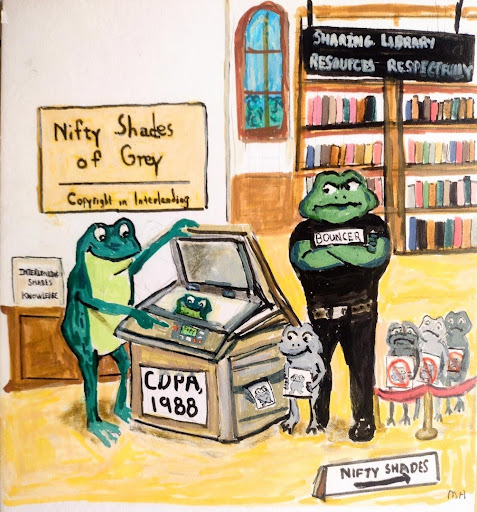
Original illustration by M.H., created in response to the themes of this article. ©M.H., 2026.

Copyright questions in interlending are rarely dramatic. They more often arrive disguised as perfectly ordinary requests.

A student needs a chapter. A researcher needs an article. Another request for the same material appears a few days later. Most can be dealt with comfortably. Every so often, though, something gives us pause:

  • Is this still an individual request, or part of a wider need? 
  • Can we rely on the declaration we’ve been given? 
  • Should we fulfil the request, ask another question or suggest a different route? 

These aren’t necessarily gaps in the law. They’re the places where our professional judgement begins.

Let’s start with the legislation

For a UK interlending service supplying a copy to an individual user, the most relevant part of the Copyright, Designs and Patents Act 1988 is section 42A.

It allows library workers to make and supply a single copy of one article from an issue of a periodical, or a reasonable proportion of another published work, without infringing copyright, provided the conditions in the section are met.

The requester must provide a declaration in writing and agree that:

  • they have not previously received a copy of the same material from a library; 
  • they need it for non-commercial research or private study; 
  • they will use it only for that purpose and will not supply it to anyone else; and 
  • to the best of their knowledge, nobody with whom they work or study is requesting substantially the same material, around the same time, for substantially the same purpose. 

The library may proceed provided it is not aware that the declaration is materially false.

That last point matters. Section 42A doesn’t require an interlending team to prove that every declaration is true. Nor does it ask us to interrogate each requester’s colleagues, supervisors or course mates. It places the request within a framework of declared purpose and good faith.

Section 41 covers the related act of supplying a single copy to another library. For journal articles, the supplying library doesn’t have to meet the usual section 41 condition around whether the person able to authorise the copying can be identified.

These provisions were rewritten in their current form by the Copyright and Rights in Performances (Research, Education, Libraries and Archives) Regulations 2014. Those regulations followed the Hargreaves Review and its recommendation that copyright exceptions should be modernised for the digital age. The reforms also allowed declarations to be submitted electronically.

Hargreaves, then, helps explain how we arrived at the present framework. Section 42A is the provision on which everyday supply to an individual is based. 

We fade to grey

The wording of section 42A is reasonably clear. Applying it across a busy interlending service is less straightforward.

Take a typical request for a book chapter. The user completes the declaration, gives non-commercial research or private study as the purpose, and provides no information that causes concern. There would normally be little reason not to proceed.

A few days later, another user requests the same chapter. That is not automatically a problem. Two people can quite independently need the same material.

Then a third request arrives, followed by a fourth, all from the same course.

At what point does a collection of individual requests start to look like teaching provision or coordinated demand?

The Act does not give us a number. It does not say that two requests are acceptable but five require intervention. The answer depends on what the service knows and what the pattern appears to show.

The first repeat request may be coincidence. A cluster of them might justify checking whether the work appears on a reading list, whether electronic access is available, or whether colleagues responsible for acquisitions or digitisation should be alerted.

That does not necessarily mean refusing the latest requester. It may mean recognising that fulfilling individual requests is no longer the only issue. 

‘Substantially the same purpose’

The declaration asks whether somebody with whom the requester works or studies is making a request for substantially the same material and substantially the same purpose.

It is an important safeguard, but not a wonderfully precise test for collaborative work.

Imagine two researchers working on the same funded project. Both need the same article, but one is studying the methodology and the other is looking at the findings. Are those substantially the same purposes?

There may not be an obvious answer.

Now consider a requester who writes:

‘I need this article for our research group, so I can send a copy to everybody before next week’s meeting.’

That is clearer. Section 42A requires the requester to state that they will not supply the copy to another person. The appropriate response would be to explain that limitation and help the group find another route.

There might be licensed access that allows every member to read the article. A link may be shareable. A subscription, purchase or other permitted form of provision may be more suitable.

This is where good service matters. ‘ILL cannot be used in that way’ may be correct, but it is only half an answer. The useful question is, ‘Which option would support what you are trying to do?’ 

In good faith

In practice, most services need to accept declarations in good faith. Anything else would make routine document supply unmanageable.

That doesn’t mean ignoring relevant information.

If a requester declares an individual research purpose, and there is no evidence to the contrary, the ILL service can usually act on that declaration.

If the requester tells us that the copy will be distributed to a class, uploaded to a shared space or circulated around a project team, we now know something we can act on. It would be difficult to ignore that information simply because the correct box has also been ticked.

Repeat requests work in a similar way. One transaction may tell us very little. A pattern may reveal a wider access need.

The judgement lies in deciding when the information is significant enough to act upon and what a proportionate response looks like.

A few good examples

The following examples are hypothetical, but they reflect the sorts of situations an interlending team can encounter.

The lecturer and her students

Several students request the same chapter. Then their lecturer also requests it.

The lecturer may have an entirely separate reason for reading it. Equally, the pattern may suggest that the chapter is being recommended for a module without suitable access being in place.

Rather than trying to judge everybody’s intentions, the ILL service could alert the relevant library team. A different solution may be needed, even if the individual requests are still fulfilled.

Two’s Company

Two colleagues working together request the same article. Each says it is for their own research.

It’s hard to know whether their purposes are substantially the same. Unless the ILL service has information showing that a declaration is materially false, a detailed investigation may be unnecessary and disproportionate.

A much larger cluster of duplicate requests from the same duo might deserve a second look though.

Resource Sharing? Me too!

A requester openly states that they intend to pass the supplied copy to somebody else.

This isn’t necessarily an attempt to evade copyright. They may simply not know that the declaration limits the use of the copy.

Offering them a short explanation, followed by help to find a lawful alternative, is likely to be more useful than treating the request as a compliance incident.

The incomplete reading list

Requests for one chapter suddenly arrive from several students.

The ILL team may be the first to see that a resource has become important to a course. Request data can therefore do more than warn us about possible copyright concerns. It can identify where access arrangements are not sufficiently meeting demand.

The best solution may lie with acquisitions, licensed access or CLA-covered provision rather than continued ILL fulfilment one request at a time.

Tales from afar

A request arrives from an overseas institution with very little information about how the material will be used.

The supplying team may seek clarification, consult the terms of the network through which the request arrived, or ask a copyright colleague for a second view.

They may still decide to supply. The point is that asking reasonable questions is sometimes part of exercising reasonable judgement. 

The free pass

Electronic resources bring another layer to the discussion.

Section 42A says that a contractual term attempting to prevent or restrict an act permitted by that section is unenforceable. Section 41 contains a similar protection.

That is wonderful to hear, but it doesn’t automatically make every electronic request uncomplicated. There may still be practical questions about access controls, technical protections, the amount being requested and the way the copy is produced and delivered.

A licence may also offer a better route than the statutory exception. It might permit sharing a stable link, access by a defined group, or another form of use that fits the requester’s needs more closely.

The aim isn’t to let every request slip through ILL simply because the exception exists. It is, or perhaps should be, to choose the most suitable lawful access route. 

Automatic for the people?

One of the great improvements in modern interlending is that straightforward requests can move through systems quickly, sometimes with very little human intervention. That is good for users and good for busy ILL teams. Nobody particularly benefits from a member of staff manually approving hundreds of entirely routine article requests.

The difficulty is that some of the judgement calls discussed above depend on somebody noticing that a request is not quite routine.

A single request for a chapter may pass through an automated workflow without giving anyone reason to pause. If several requests for the same chapter arrive from the same course, though, a person looking at the pattern might start asking whether there is a wider access issue.

Likewise, something written in a request note might reveal an intention to share a supplied copy more widely, but only if that information is noticed by a human.

This creates a balancing act. How many checks can be added into automated workflows before the efficiency gained starts to vanish?

Putting every request through manual copyright checking would rather defeat the point of automation. At the other extreme, a completely hands-off workflow risks making some of these grey areas invisible.

Perhaps the useful middle ground is to think less about checking everything and more about deciding what ought to trigger a second look. That might include unusual request information, patterns of repeat demand, particular categories of request, or other circumstances specific to local workflows.

Automation doesn’t cancel out professional judgement, then. It simply changes where we seek to apply it.

Which brings us back to the spirit of Hargreaves. We want systems that enable access efficiently, while still leaving enough room for a human being to notice when an ordinary request has become something a little less ordinary.

Who am I to judge?

For me, a workable approach has four components.

  1. Accept declarations in good faith unless there is a reason not to. 
  2. Pay attention to what the requester is saying. A signed declaration doesn’t cancel out conflicting statements elsewhere in the request. 
  3. Notice patterns. ILL offers us an early glimpse of unmet teaching and research demand. 
  4. Be prepared to redirect rather than refuse. A request that doesn’t fit section 42A may still be entirely reasonable, but it may need a different solution. 

None of this produces perfect certainty. It does, however, provide a defensible and human way to operate a service while working within shades of grey. 

A compromise

There are two tempting extremes.

The first is to become so cautious that any uncertainty results in refusing a request. That protects the ILL service from making difficult decisions, but it may also prevent activity that the law was designed to allow.

The second is to regard every grey area as a convenient opening and avoid asking questions that might complicate fulfilment.

Neither feels right.

The space between them is undeniably messy. It requires us to read a request, consider what we know and decide whether the proposed use still fits the exception.

The same compromise applies to our systems. We can introduce so many compliance checks that automation becomes cumbersome, or so few that we lose sight of the circumstances in which judgement is needed. So, when we’re investigating whether a process can be automated, we also need to consider where human attention is necessary.

It’s beneficial for us to discuss difficult cases as a community. Local guidelines are useful, of course, but so are conversations between practitioners. Hearing how another ILL team has handled repeat requests, collaborative projects, international supply or automated workflows can expose assumptions in our own practices and help the community develop a more consistent approach.

There will probably never be one simple answer for every uncertain request. I’m not sure there should be, and it is precisely these kinds of puzzles that make our line of work so interesting.

Interlending depends on trust, reciprocity and a willingness to make careful decisions with incomplete information. Copyright legislation gives us a framework. Our shared professional practice fills in the gaps. 

In other words, shades of grey aren’t something to be embarrassed about. They are simply where the good thinking happens.

FIL would be interested to hear how other members approach these cases:

  • At what point do repeat requests become a pattern?
  • When do you seek more information, and when do you accept the declaration and proceed? 
  • Where have you chosen to put human checks into an otherwise automated workflow, and why?
Four Libraries, One Service: ILL at University of Dundee

Four Libraries, One Service: ILL at University of Dundee

By Finlay Beatson, Library Support Advisor, University of Dundee

When Kip suggested this little morsel to me, I hadn’t quite realised what a unique situation it was. For the vast majority of our interlending colleagues, we have one or perhaps two libraries to keep track of, each of them likely in close proximity to each other for ease of access. The University of Dundee has four libraries; two on Main Campus (our Main Library and Duncan of Jordanstone Library), one in Ninewells Hospital, and another across the river in the heart of Fife – our Kirkcaldy Campus library! The Robertson Trust Medical Library in Ninewells is approximately a 10 minute drive from our Main Library, while Kirkcaldy is a whopping 50 minutes away. We also have three remote store ‘rooms’ we pick from, which brings the grand total of locations to seven – quite the number for a tight-knit institution! And, believe it or not, there used to be more!

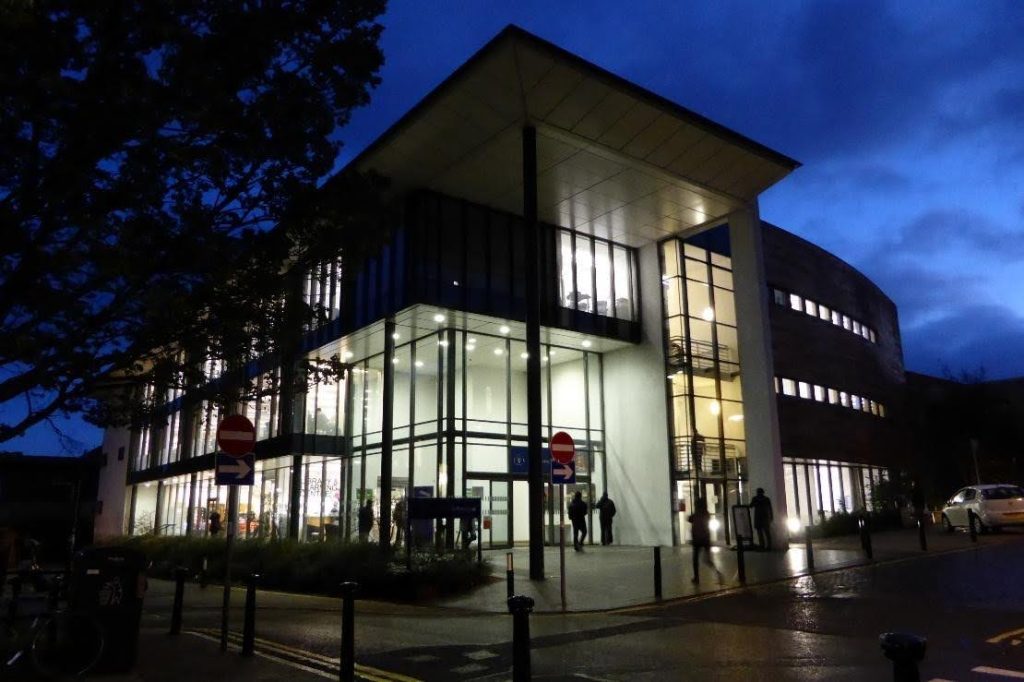
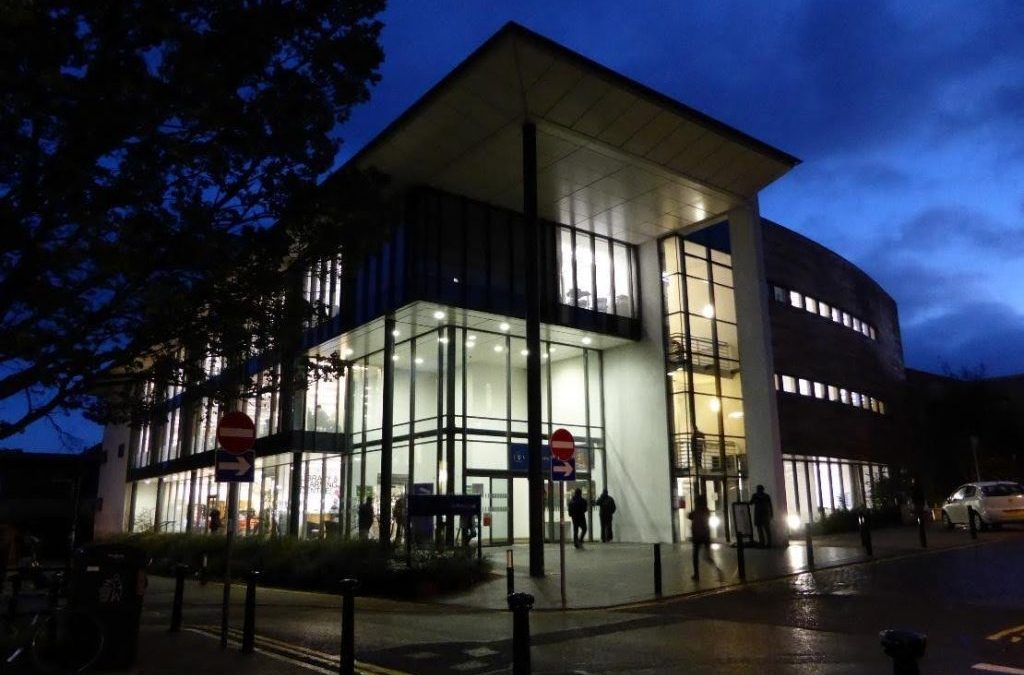
University of Dundee Library at night, John Lord, CC BY 2.0, via Wikimedia Commons.


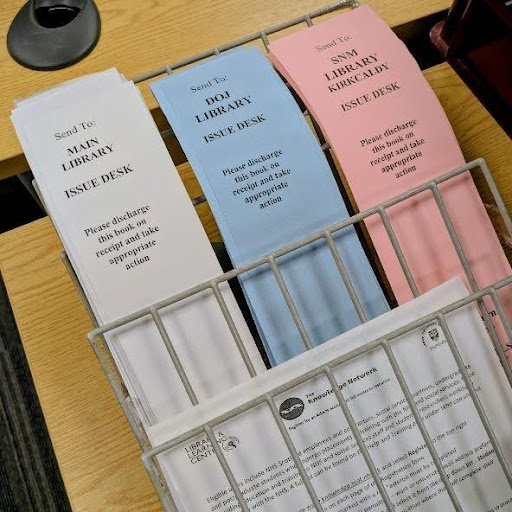
So how does having seven locations influence our Resource Sharing service, especially considering our ILL department is based at Ninewells? Organisation is a huge factor in this, as well as communication. As of now we are quite the well-oiled machine; ILLs have always been based at Ninewells and we have always had our seven locations, so the dynamics within our locations are iron-clad. Books are transferred between the three Dundee-based libraries and Kirkcaldy campus every week, each with separate boxes that line the wall of the Main Library, slips are colour-coded based on library (Ninewells is bright blue, if you must know!) and whether they are internal or external titles, just as a few examples! Requests are placed as early as possible so they can be picked and transported to our ILL department that day, minimising wait time between processing and posting. On the other end, we add an extra week to our due dates, just in case there is an unexpected delay on the way to our mailroom. 


Photograph © Finlay Beatson. Reproduced with permission.


Speaking of wait time, deciding the most optimal routes between sites considers multiple factors. Firstly, there’s demand. Which sites are most popular with our ILL patrons, what titles see the most footfall, and where are we going to need to spend the longest? Secondly, location; how many locations can we reach in the shortest time? Luckily for us, two of our stores are located almost underneath two libraries, so hitting two birds with one stone has never been easier. And thirdly… The gas tank. Books need to traverse about in one piece! Our devoted logistics attendant keeps a careful eye on the mileage – we certainly couldn’t be providing the service we do without them! Ninewells is always last on the stop, Main Library always the first. 


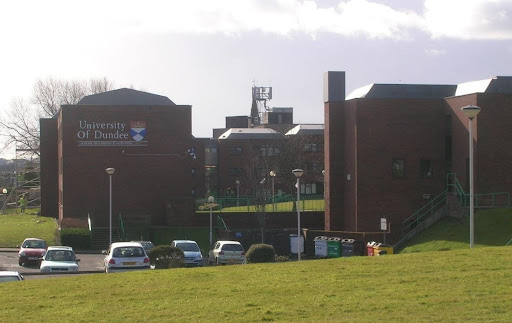
University of Dundee Kirkcaldy: Kilnburn, Wikimedia Commons. Used under an attribution-only licence.


Handling numerous libraries is one of a few great hurdles in Resource Lending; not only is there different stock and requirements, but oftentimes colleagues are neither trained in Interlending nor have the capacity to. We’re all aware of how busy HE libraries can be – and how bitty Interlending can really be. Inter Library departments can contain only one or two people, sometimes across different sites, meaning forwarding emails and discussing requests over Teams is more commonplace. We risk accepting requests without physically seeing the book until it arrives at our doorstep, trusting our colleagues to make the judgement on whether it is truly suitable for lending or not and to notify us. This can lead to a few mishaps, I know I’ve spent way too long rubbing pencil marks out of books only to receive word I’ve missed some, or we’ve had to reject requests based on quality and rarity in other sites. Though whether we have one, seven, or even twenty-three sites (looking at you, Bodleian, with love), providing the best service is always top priority, and I’m sure all of us will remain as passionate as ever about this small yet mighty facet of Library Services.


Phil the ILL Frog: A Southampton Sojourn

Phil the ILL Frog: A Southampton Sojourn

By Lesley Gooding, Principal Library Assistant, University of Southampton Library

In August 2026, our Associate Director, Dr Jonathan Chipp, presented the Acquisitions team at Hartley Library, University of Southampton, with a beautiful green plush frog from the Interlend 2026 Conference.

Phil had originally been given to Jonathan as a thank you for co-presenting a session on the Research Libraries UK (RLUK) Collections Strategy Network (CSN) and its vision for redefining interlending. Jonathan generously passed him on to us.

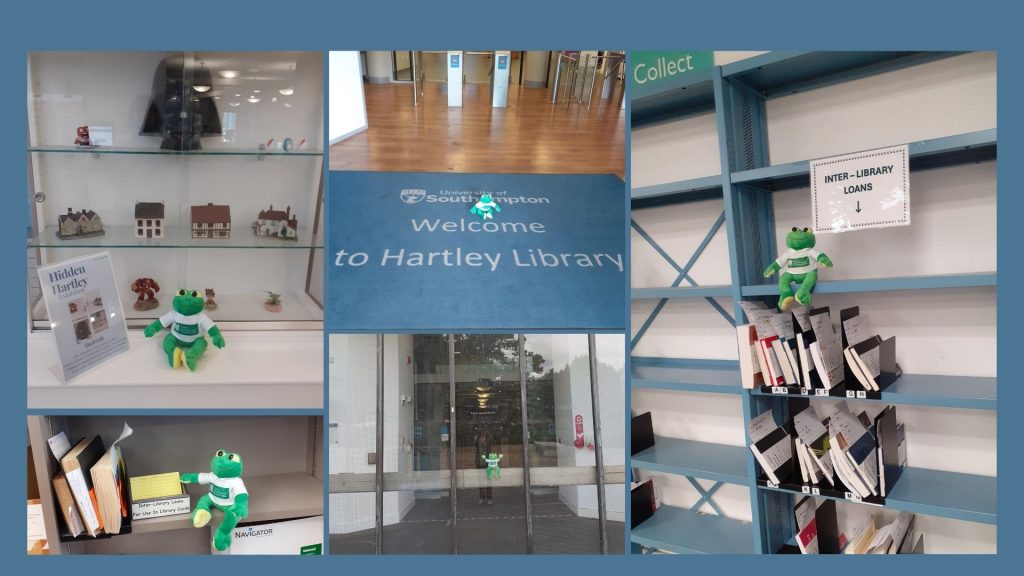
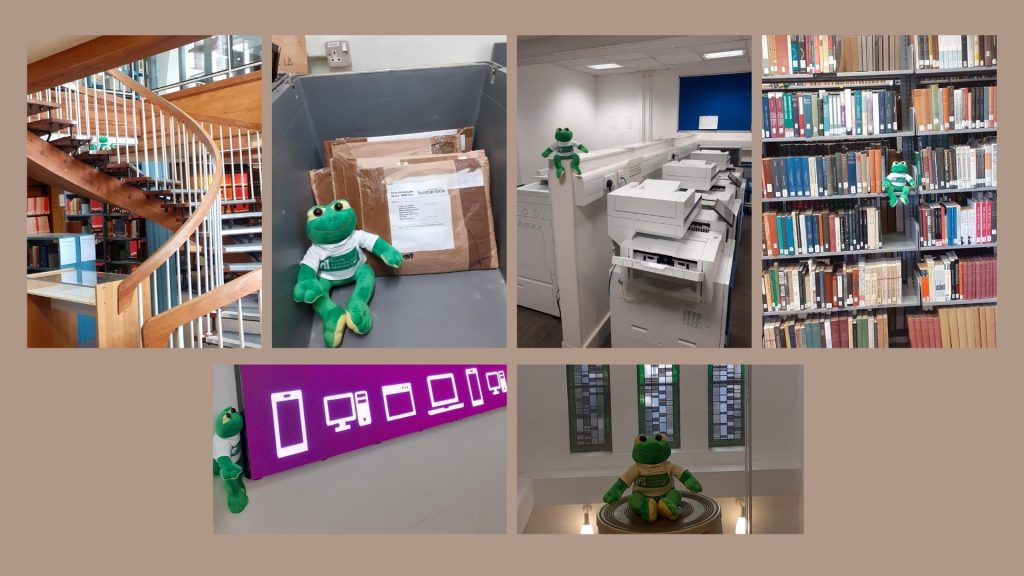
We immediately adopted the name Phil (for FIL), and a space was created for him on the ILL shelves at Hartley Library. He quickly settled into his new habitat, and we decided that his first task should be a tour of the library, as seen in the attached photos.  

(Photos by Lesley, location selection by Verna, postcard collage created by Dace)

Left-hand photo – this is from a display called Hidden Hartley, which included some of the interesting finds discovered within the stacks during a large stock move two years ago – including a Darth Vader helmet! Phil seemed particularly interested in the helmet. 

Underneath are the Reference Only ILL books, which are signed in and out.

Centre section – the Hartley Library entrance from outside and the foyer.

Right-hand photo – this is where ILL books are kept awaiting collection. We have our own custom-made paper bands to distinguish ILL books from our own library books.


Left-hand photo – this is the most photographed part of the library: our spiral staircase. It is very popular for graduation photos and has even been the setting for at least one marriage proposal that we know of.

Phil waited hopefully for a while. Perhaps he was expecting a frog princess.

Other photos

  • The many ILL parcels sent out each day 
  • The IT Tech Hub 
  • The stained glass, which forms part of a design by Ray Bradley representing the DNA code of fish 
  • Some of our many bookshelves 

While exploring the shelves, Phil was pleased to discover The Little Frog’s Guide to Self-Care by Maybell Eequay – reassuring evidence that Hartley Library takes the wellbeing of its amphibian visitors seriously.

He was rather less enthusiastic about finding Brian Tracy’s Eat That Frog!


A little bit about the library and us

The Hartley Library is the main library on our Highfield campus. We have three other specialised site libraries: Winchester School of Art (WSA) Library; the Health Services Library (HSL) at University Hospital Southampton for NHS and University patrons; and the National Oceanographic Library at the Waterfront campus.

WSA and HSL deal with their own ILL requests, with our assistance if needed. Otherwise, all other requests come to us at Hartley Library.

ILL is part of the University of Southampton Library’s Acquisitions team. At present, we have three colleagues at Hartley Library working on ILL requests and purchasing: Lesley, Verna and Dace. Both Verna and Lesley have been with the University in various roles for over 30 years, and Dace joined us three years ago.

I am very proud to work in Acquisitions on Interlibrary Loans with such a great, hardworking team. We often receive positive feedback from our patrons, which is always well deserved.

ILL is a very individual service, and knowing that we have helped someone track down that elusive reference – and seeing them complete their PhD – is very satisfying. We often feel like detectives, and one of us was once described as a wizard for locating obscure items!

I very much enjoyed the Interlend 2026 conference this year. I was particularly interested in the presentation by Charlotte Jones from the Barbican Music Library, as sourcing orchestral scores is a very labour-intensive task. It is always great to meet other ILL colleagues, exchange thoughts and ideas, and catch up on new developments.

We have loved having Phil in our office. The frog is a real talking point, has brightened our days and has certainly caught people’s imagination.

There was even talk on a family WhatsApp that a knitted Dalek called Derek may have a little crush on Phil.

Who knows where Phil will go next…

Reflecting on Security Practices for Physical ILLs

Reflecting on Security Practices for Physical ILLs

Written by Kip A. Darling, with information collected and shared by Rachel Simcock, Collections Team Leader (Document Delivery), Library & University Collections, University of Edinburgh

Image showing library books on a shelf

‘Bookshelves’ by The CCAC North Campus library, licensed under CC BY 2.0 [https://creativecommons.org/licenses/by/2.0/]

Back in March, I put out a query to colleagues regarding security levels for physical interlibrary loans. Many thanks to everyone who took the time to respond. In total, 17 institutions replied, alongside our own local response, giving us a helpful snapshot across 18 libraries.

What emerged was a surprisingly strong level of consistency across the sector.

Nearly all respondents described applying higher security controls to ILL materials than to their own circulating stock. Staff mediation, restricted access, and controlled handover points appear to be the norm from start to finish. Self-service or open shelf access is very much the exception, and usually only considered where the perceived risk is minimal.

Some of the clearest patterns included:

17 respondents store ILLs in staff-controlled, restricted, or lockable areas rather than on open shelves.
16 respondents issue ILLs only via library staff rather than self-service.
16 respondents also require returns directly to staff or designated drop points.
13 respondents manage ‘library use only’ items through supervised access, often retaining the user’s ID during consultation.
No respondents offer postal home loans of physical ILLs to students.

Only two respondents reported allowing standard physical ILLs to be collected from open shelves, and even then, only for unrestricted loans.

One interesting point was that, while most libraries maintain tight operational control over ILL handling, relatively few use formal tracking systems beyond normal institutional processes. A handful of libraries keep spreadsheets, logbooks, or signed tracking sheets for parcels moving through mailrooms, particularly for international or higher-value items. Most, however, rely on established workflows, staff-only areas, and the general reliability of university postal and facilities teams.

The responses also highlighted how much the smooth running of ILL services depends on colleagues outside the library. In many institutions, library staff are not directly involved at every stage once items enter the university post system, but handover points are still almost always restricted access or staff-only. Libraries generally expressed confidence in these arrangements, helped by the fact that missing ILL parcels appear to be extremely rare in practice.

Perhaps the most reassuring finding was that no library reported having zero staff or security oversight of physical ILLs. Even where additional tracking measures are minimal, there is still a clear culture of controlled handling and professional stewardship surrounding these materials.

Overall, the responses suggest that the current balance of secure spaces, staff mediation, and trusted institutional processes is working well. It was also genuinely interesting to see how much quiet consistency exists across the community. Different libraries may use slightly different workflows, but the underlying principle seems widely shared: physical ILLs are treated with a little extra care, and for good reason.

Summer Interlend 2026 Booking Now Open!

Summer Interlend 2026 Booking Now Open!

A picture of a smiling green frog wearing a FIL top, with the words 'FIL - Interlend 2026'

Join us for our online Interlend 2026 Conference.

There’s only two weeks to go until Summer Interlend 2026! FIL is excited to share our agenda for the conference.

Emails with instructions on how to join the event will be sent on Monday 8th June.

You can still register for Summer Interlend 2026 here.

We look forward to seeing you (virtually) there!

Timings Topic & Speaker
10:30-10:40 (10 min) Welcome, housekeeping 

Kip A. Darling, FIL Chair

Your FIL Committee

Joanne Booker, (Bodleian), Roana Mourad (Glasgow Caledonian), Sarah Hornby (Newcastle University), Muriel Munguia (Edinburgh University), with apologies from Alex Priestman (Warwick University) & Jo Cox (British Library)

10:40-11:20 (40 min) British Library High Density Print Storage
Jonathan Meeson (BL)
11:20-11:40 (20 min) BL Update

Richard Ebdon (BL)

11:40-12pm  BREAK – opportunity to network in breakout rooms (20 min)
12pm- 12:20 (20 min) Lightning Talk: ILL Copyright – UK Statutes and Overseas supply

Andrew Johnson (Sheffield University) 

12:20 – 12:40 (20 min) The Barbican Music Library, the IAML UK & IRL Documentation Committee and the Encore Monitoring Group

Charlotte Jones (The Barbican Music Library)

12:40 – 1pm (20 min) Lightning Talk: Redefining ILL: RLUK CSN’s vision

Helen Faulds (University of St Andrews) and Jonathan Chipp (University of Southampton)

1pm-1:45pm LUNCH BREAK (45 min)
1:45- 2:45pm (60 min) ISO Panelists & discussion:

  • Bronwen Blatchford (Cardiff University, on behalf of WHELF+), 
  • Kevin O’Donovan (London School of Economics) 
  • Allen Jones (The New School)
2:45-3:15  (10 min) 

(20 min)

The Google status update sheet/ making use of the FIL website 

Roana Mourad (Glasgow Caledonian), on behalf of FIL Committee

An update on future plans for FIL

Kip A. Darling, FIL Chair

3:15 – 3:35  BREAK – opportunity to network in breakout rooms  (20 min)
3:35-4pm 

(25 mins) 

Building a National Lending Network in Australia
Allen Jones (The New School Libraries, NY, USA)
4pm  Close

Emails with instructions on how to join the event will be sent on Monday 8th June.

You can still register for Summer Interlend 2026 here.

We look forward to seeing you (virtually) there!

Summer Interlend 2026 Booking Now Open!

Summer Interlend 2026 Booking Now Open!

A stylised woodcut-style illustration of a person sitting at a desk, with a laptop open in front of them that reads "Interlibrary Loan Form". There are books on the desk and on shelves around the room. A large window in front of them looks outside on a sunny day.

Join us for our online Interlend 2026 Conference.

We’re pleased to confirm that booking for Interlend 2026 is now open! This is a free event and will be online, held on Wednesday 10th June 10:00-16:30.

Register here.

A joining link for the event will be sent to you following your registration. 

The draft programme will be confirmed over the following week, and will be published on the website. The event will include a panel discussion on automated resource sharing between library systems, focusing on how ISO workflows are being used in day-to-day practice, for both loans and copies. Other talks will focus on ILL and copyright, the Australian national lending network, the Barbican Music Library, the IAML UK&IRL Documentation Committee and the Encore Monitoring Group.

We look forward to seeing you all there!

Website Logo
Privacy Overview

This website uses cookies so that we can provide you with the best user experience possible. Cookie information is stored in your browser and performs functions such as recognising you when you return to our website and helping our team to understand which sections of the website you find most interesting and useful.