
By Kip A. Darling in consultation with Liesl Rowe FHEA
This is a practitioner’s reflection on copyright and interlending, rather than legal advice.
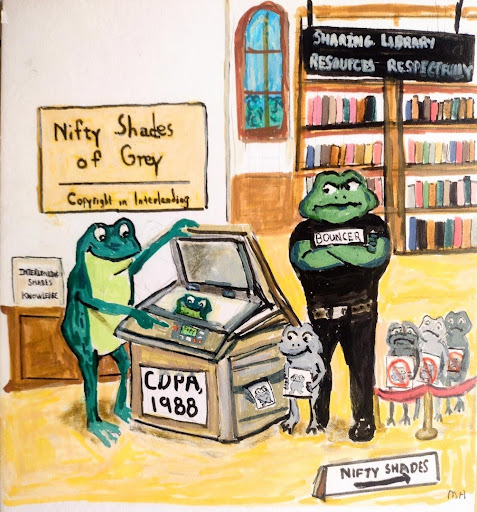
Original illustration by M.H., created in response to the themes of this article. ©M.H., 2026.
Copyright questions in interlending are rarely dramatic. They more often arrive disguised as perfectly ordinary requests.
A student needs a chapter. A researcher needs an article. Another request for the same material appears a few days later. Most can be dealt with comfortably. Every so often, though, something gives us pause:
- Is this still an individual request, or part of a wider need?
- Can we rely on the declaration we’ve been given?
- Should we fulfil the request, ask another question or suggest a different route?
These aren’t necessarily gaps in the law. They’re the places where our professional judgement begins.
Let’s start with the legislation
For a UK interlending service supplying a copy to an individual user, the most relevant part of the Copyright, Designs and Patents Act 1988 is section 42A.
It allows library workers to make and supply a single copy of one article from an issue of a periodical, or a reasonable proportion of another published work, without infringing copyright, provided the conditions in the section are met.
The requester must provide a declaration in writing and agree that:
- they have not previously received a copy of the same material from a library;
- they need it for non-commercial research or private study;
- they will use it only for that purpose and will not supply it to anyone else; and
- to the best of their knowledge, nobody with whom they work or study is requesting substantially the same material, around the same time, for substantially the same purpose.
The library may proceed provided it is not aware that the declaration is materially false.
That last point matters. Section 42A doesn’t require an interlending team to prove that every declaration is true. Nor does it ask us to interrogate each requester’s colleagues, supervisors or course mates. It places the request within a framework of declared purpose and good faith.
Section 41 covers the related act of supplying a single copy to another library. For journal articles, the supplying library doesn’t have to meet the usual section 41 condition around whether the person able to authorise the copying can be identified.
These provisions were rewritten in their current form by the Copyright and Rights in Performances (Research, Education, Libraries and Archives) Regulations 2014. Those regulations followed the Hargreaves Review and its recommendation that copyright exceptions should be modernised for the digital age. The reforms also allowed declarations to be submitted electronically.
Hargreaves, then, helps explain how we arrived at the present framework. Section 42A is the provision on which everyday supply to an individual is based.
We fade to grey
The wording of section 42A is reasonably clear. Applying it across a busy interlending service is less straightforward.
Take a typical request for a book chapter. The user completes the declaration, gives non-commercial research or private study as the purpose, and provides no information that causes concern. There would normally be little reason not to proceed.
A few days later, another user requests the same chapter. That is not automatically a problem. Two people can quite independently need the same material.
Then a third request arrives, followed by a fourth, all from the same course.
At what point does a collection of individual requests start to look like teaching provision or coordinated demand?
The Act does not give us a number. It does not say that two requests are acceptable but five require intervention. The answer depends on what the service knows and what the pattern appears to show.
The first repeat request may be coincidence. A cluster of them might justify checking whether the work appears on a reading list, whether electronic access is available, or whether colleagues responsible for acquisitions or digitisation should be alerted.
That does not necessarily mean refusing the latest requester. It may mean recognising that fulfilling individual requests is no longer the only issue.
‘Substantially the same purpose’
The declaration asks whether somebody with whom the requester works or studies is making a request for substantially the same material and substantially the same purpose.
It is an important safeguard, but not a wonderfully precise test for collaborative work.
Imagine two researchers working on the same funded project. Both need the same article, but one is studying the methodology and the other is looking at the findings. Are those substantially the same purposes?
There may not be an obvious answer.
Now consider a requester who writes:
‘I need this article for our research group, so I can send a copy to everybody before next week’s meeting.’
That is clearer. Section 42A requires the requester to state that they will not supply the copy to another person. The appropriate response would be to explain that limitation and help the group find another route.
There might be licensed access that allows every member to read the article. A link may be shareable. A subscription, purchase or other permitted form of provision may be more suitable.
This is where good service matters. ‘ILL cannot be used in that way’ may be correct, but it is only half an answer. The useful question is, ‘Which option would support what you are trying to do?’
In good faith
In practice, most services need to accept declarations in good faith. Anything else would make routine document supply unmanageable.
That doesn’t mean ignoring relevant information.
If a requester declares an individual research purpose, and there is no evidence to the contrary, the ILL service can usually act on that declaration.
If the requester tells us that the copy will be distributed to a class, uploaded to a shared space or circulated around a project team, we now know something we can act on. It would be difficult to ignore that information simply because the correct box has also been ticked.
Repeat requests work in a similar way. One transaction may tell us very little. A pattern may reveal a wider access need.
The judgement lies in deciding when the information is significant enough to act upon and what a proportionate response looks like.
A few good examples
The following examples are hypothetical, but they reflect the sorts of situations an interlending team can encounter.
The lecturer and her students
Several students request the same chapter. Then their lecturer also requests it.
The lecturer may have an entirely separate reason for reading it. Equally, the pattern may suggest that the chapter is being recommended for a module without suitable access being in place.
Rather than trying to judge everybody’s intentions, the ILL service could alert the relevant library team. A different solution may be needed, even if the individual requests are still fulfilled.
Two’s Company
Two colleagues working together request the same article. Each says it is for their own research.
It’s hard to know whether their purposes are substantially the same. Unless the ILL service has information showing that a declaration is materially false, a detailed investigation may be unnecessary and disproportionate.
A much larger cluster of duplicate requests from the same duo might deserve a second look though.
Resource Sharing? Me too!
A requester openly states that they intend to pass the supplied copy to somebody else.
This isn’t necessarily an attempt to evade copyright. They may simply not know that the declaration limits the use of the copy.
Offering them a short explanation, followed by help to find a lawful alternative, is likely to be more useful than treating the request as a compliance incident.
The incomplete reading list
Requests for one chapter suddenly arrive from several students.
The ILL team may be the first to see that a resource has become important to a course. Request data can therefore do more than warn us about possible copyright concerns. It can identify where access arrangements are not sufficiently meeting demand.
The best solution may lie with acquisitions, licensed access or CLA-covered provision rather than continued ILL fulfilment one request at a time.
Tales from afar
A request arrives from an overseas institution with very little information about how the material will be used.
The supplying team may seek clarification, consult the terms of the network through which the request arrived, or ask a copyright colleague for a second view.
They may still decide to supply. The point is that asking reasonable questions is sometimes part of exercising reasonable judgement.
The free pass
Electronic resources bring another layer to the discussion.
Section 42A says that a contractual term attempting to prevent or restrict an act permitted by that section is unenforceable. Section 41 contains a similar protection.
That is wonderful to hear, but it doesn’t automatically make every electronic request uncomplicated. There may still be practical questions about access controls, technical protections, the amount being requested and the way the copy is produced and delivered.
A licence may also offer a better route than the statutory exception. It might permit sharing a stable link, access by a defined group, or another form of use that fits the requester’s needs more closely.
The aim isn’t to let every request slip through ILL simply because the exception exists. It is, or perhaps should be, to choose the most suitable lawful access route.
Automatic for the people?
One of the great improvements in modern interlending is that straightforward requests can move through systems quickly, sometimes with very little human intervention. That is good for users and good for busy ILL teams. Nobody particularly benefits from a member of staff manually approving hundreds of entirely routine article requests.
The difficulty is that some of the judgement calls discussed above depend on somebody noticing that a request is not quite routine.
A single request for a chapter may pass through an automated workflow without giving anyone reason to pause. If several requests for the same chapter arrive from the same course, though, a person looking at the pattern might start asking whether there is a wider access issue.
Likewise, something written in a request note might reveal an intention to share a supplied copy more widely, but only if that information is noticed by a human.
This creates a balancing act. How many checks can be added into automated workflows before the efficiency gained starts to vanish?
Putting every request through manual copyright checking would rather defeat the point of automation. At the other extreme, a completely hands-off workflow risks making some of these grey areas invisible.
Perhaps the useful middle ground is to think less about checking everything and more about deciding what ought to trigger a second look. That might include unusual request information, patterns of repeat demand, particular categories of request, or other circumstances specific to local workflows.
Automation doesn’t cancel out professional judgement, then. It simply changes where we seek to apply it.
Which brings us back to the spirit of Hargreaves. We want systems that enable access efficiently, while still leaving enough room for a human being to notice when an ordinary request has become something a little less ordinary.
Who am I to judge?
For me, a workable approach has four components.
- Accept declarations in good faith unless there is a reason not to.
- Pay attention to what the requester is saying. A signed declaration doesn’t cancel out conflicting statements elsewhere in the request.
- Notice patterns. ILL offers us an early glimpse of unmet teaching and research demand.
- Be prepared to redirect rather than refuse. A request that doesn’t fit section 42A may still be entirely reasonable, but it may need a different solution.
None of this produces perfect certainty. It does, however, provide a defensible and human way to operate a service while working within shades of grey.
A compromise
There are two tempting extremes.
The first is to become so cautious that any uncertainty results in refusing a request. That protects the ILL service from making difficult decisions, but it may also prevent activity that the law was designed to allow.
The second is to regard every grey area as a convenient opening and avoid asking questions that might complicate fulfilment.
Neither feels right.
The space between them is undeniably messy. It requires us to read a request, consider what we know and decide whether the proposed use still fits the exception.
The same compromise applies to our systems. We can introduce so many compliance checks that automation becomes cumbersome, or so few that we lose sight of the circumstances in which judgement is needed. So, when we’re investigating whether a process can be automated, we also need to consider where human attention is necessary.
It’s beneficial for us to discuss difficult cases as a community. Local guidelines are useful, of course, but so are conversations between practitioners. Hearing how another ILL team has handled repeat requests, collaborative projects, international supply or automated workflows can expose assumptions in our own practices and help the community develop a more consistent approach.
There will probably never be one simple answer for every uncertain request. I’m not sure there should be, and it is precisely these kinds of puzzles that make our line of work so interesting.
Interlending depends on trust, reciprocity and a willingness to make careful decisions with incomplete information. Copyright legislation gives us a framework. Our shared professional practice fills in the gaps.
In other words, shades of grey aren’t something to be embarrassed about. They are simply where the good thinking happens.
FIL would be interested to hear how other members approach these cases:
- At what point do repeat requests become a pattern?
- When do you seek more information, and when do you accept the declaration and proceed?
- Where have you chosen to put human checks into an otherwise automated workflow, and why?
FIL Web Officer
Alex is the Acquisitions Officer for the University of Warwick Library.